

Pick the wrong nutrients for the veg stage and your cannabis plants pay for it long after you have flipped to flower. Under-fed weed plants enter the flowering stage with underdeveloped roots, thin stems, and fewer bud sites. Overfed ones deal with nutrient burn and pH problems that slow growth just as badly.
Knowing how to grow weed well starts with understanding what cannabis plants need before they ever produce a bud.
This guide covers the best nutrients for the veg stage: what macronutrients and micronutrients marijuana plants need, how to read fertilizer labels, how organic and synthetic options compare, how to build a practical feeding schedule, and how to maximize vegetative growth without the mistakes that cost growers time and yield.
What Happens During the Cannabis Vegetative Stage
After the seedling stage, cannabis plants enter a period of rapid development focused entirely on structure. The plant focuses on roots, stems, and leafy growth rather than reproduction. Roots push through the growing medium to build the water and nutrient uptake capacity the plant will rely on during flowering.
For indoor growers, the light cycle controls how long plants stay in veg. Running 18 hours of light per day keeps weed plants in the vegetative growth stage. Most indoor growers veg their cannabis seeds for 4 to 10 weeks before switching to a 12/12 cycle to trigger flowering.
Outdoor marijuana plants follow the natural seasonal light cycle. During the vegetative stage, male and female plants look nearly identical, which is why most growers start with feminized cannabis seeds. Autoflowering plants transition on their own schedule after 3 to 4 weeks of veg, regardless of hours of light.
Why What Happens in Veg Determines Yield
More bud sites develop during the vegetative growth stage than at any other point. The structural decisions made during veg, including how wide the canopy spreads and how deep the root mass extends, directly set the ceiling for how much flower the plant can carry.
Cannabis plants thrive when their vegetative phase is managed well. Higher yields are a product of healthy vegetative growth and sound cannabis cultivation practices, not just what happens during flower.
Primary Plant Nutrients: NPK Explained
The three numbers on fertilizer labels represent nitrogen, phosphorus, and potassium in that order. These are the primary plant nutrients cannabis requires in the largest quantities, and their ideal ratio changes significantly between the veg and flowering phases.
Nitrogen: The Driver of Leafy Growth
Nitrogen is the most critical nutrient during the cannabis vegetative stage. It drives chlorophyll production for continued plant growth and builds the amino acids that regulate plant metabolism. To boost plant health during the seedling stage and early veg, start with a light nitrogen dose and increase gradually as the plant establishes.
When nitrogen runs low, older leaves yellow from the bottom of the plant upward as the plant pulls nitrogen from mature tissue to support new growth. Too much nitrogen causes excess leafy growth and, if carried into flower, suppresses bud formation by keeping the plant focused on vegetative growth rather than reproduction.
Phosphorus: Roots and Energy Transfer
Phosphorus supports root development and the conversion of light into usable sugars. A strong root mass built during the vegetative growth stage gives cannabis plants the uptake capacity they need when flowering demand increases. Phosphorus deficiency in veg shows as slow plant growth, purpling of leaves, and delays in bud formation.
Potassium: Regulation and Resilience
Potassium regulates water uptake, activates enzymes involved in plant growth, and strengthens cell walls. Its absence shows as browning leaf edges, weakened stems, and sluggish overall plant development. Adequate potassium also helps cannabis plants handle the physical stress of low stress training without snapping.
NPK Ratios for Healthy Vegetative Growth
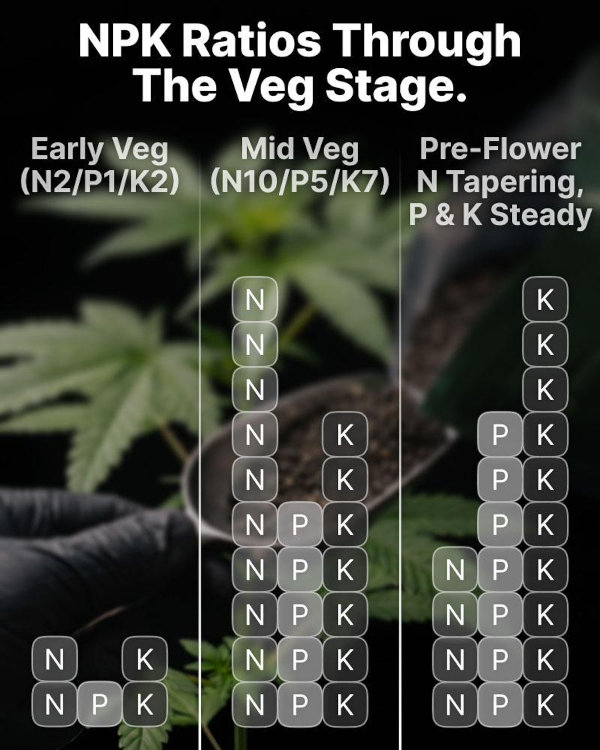
A nitrogen-forward ratio is the standard approach for the cannabis veg stage. A starting ratio of roughly 3:1:2 (N:P:K) works well for most setups. Early in veg, a lighter formula around 2:1:2 introduces younger cannabis plants to nutrients without risking burn.
By mid-veg, many growers move toward something closer to a 10:5:7 ratio as rapid growth and vertical growth accelerate. As the plant prepares for the flip to flower, tapering nitrogen gradually in the final week reduces the risk of excess nitrogen suppressing bud formation in early flower.
Secondary Nutrients: Calcium, Magnesium, and Sulfur
Beyond the primary NPK trio, cannabis plants need three secondary macronutrients that directly affect plant health during the veg phase. Deficiencies in any of them can stall healthy growth just as effectively as a primary nutrient shortage.
Calcium
Calcium reinforces cell walls, supports root health, and plays a role in nutrient transport throughout the plant. It shows up as a deficiency in new growth first, causing crinkled leaves and weak stems. Calcium is particularly prone to deficiency in hydroponic systems and coco coir grows, where it must come directly from the nutrient solution rather than from natural soil reserves.
Magnesium
Magnesium sits at the centre of every chlorophyll molecule, making it directly tied to photosynthesis. Without it, cannabis plants develop interveinal chlorosis, yellowing between the leaf veins while the veins themselves remain green.
Growers using reverse osmosis water or soft water are most likely to encounter magnesium shortfalls during rapid vegetative growth. A cal-mag supplement addresses both calcium and magnesium together.
Sulfur
Sulfur contributes to protein synthesis, enzyme activity, and chlorophyll production. Deficiency is less common than calcium or magnesium issues but appears as general yellowing of new growth starting at the leaf midsection. Most quality cannabis nutrient lines include sufficient sulfur without requiring separate supplementation.
Micronutrients: Small Amounts, Essential Functions
Cannabis plants also require trace amounts of iron, zinc, manganese, copper, boron, and molybdenum. These micronutrients are needed in far smaller quantities than macronutrients, but their absence disrupts enzyme function and overall plant metabolism in ways that can mimic macronutrient deficiencies.
In organic soil, micronutrients are typically present without supplementation. In coco coir and hydroponic systems, they must come from the nutrient solution. Using cannabis-specific lines rather than general-purpose fertilizers is the simplest way to ensure marijuana plants get the micronutrient depth they need for robust growth.
Silica is not an essential nutrient but is worth adding for those growing indoors in coco or hydro. It strengthens cell walls to support stem growth and improves resistance to heat and pests. Outdoor soils typically contain adequate natural silica.
Beneficial Microbes, Organic Compounds, and Root Health
Healthy vegetative growth depends not just on which nutrients are present but on whether the root zone can access them. Beneficial microbes, including beneficial bacteria and beneficial fungi such as mycorrhizae, form relationships with cannabis roots that improve nutrient and water uptake.
Mycorrhizal fungi extend the reach of the root system, while beneficial bacteria break down organic compounds in the growing medium into plant-available forms. Growers who use living amendments often see more vigorous growth and better plant resilience than those using sterile synthetic setups.
Products like advanced nutrients formulas that include microbial inoculants support this biological layer alongside direct plant feeding, helping cannabis plants achieve optimal growth from the root zone up.
Root rot is a serious threat to plant health in hydroponic setups. It develops when reservoir temperatures are too warm, oxygenation is poor, or equipment is contaminated.
A plant dealing with root rot cannot absorb plant nutrients efficiently regardless of the nutrient solution. Keeping water temperatures below 72°F and introducing beneficial bacterial products as a preventative measure are the most effective defences.
Organic Nutrients vs. Synthetic Fertilizers in the Veg Stage
Organic Nutrients
Organic nutrients come from natural sources: compost, worm castings, bat guano, fish meal, kelp, and other organic compounds that release gradually as microbial activity breaks them down. This slower release reduces the risk of nutrient burn and builds soil health over time.
The trade-off is that correcting a deficiency takes longer, and a growing medium lacking microbial life will not convert organic compounds efficiently.
Synthetic Fertilizers
Synthetic fertilizers offer precise, immediately available nutrition. What fertilizer labels show is what the plant receives, and adjustments take effect within a watering cycle. This makes synthetic feeding practical for hydroponic systems and coco coir, and useful when a deficiency needs correcting quickly.
The risk is salt accumulation over time, which disrupts pH and causes nutrient lockout if the medium is not flushed periodically.
Building a Vegetative Stage Feeding Schedule
Start at Half Strength
Cannabis nutrient schedules are typically written for mature, established plants. Vegging plants in the seedling stage are more sensitive to salt accumulation and high nutrient concentration. Begin at half strength and increase only when plants show signs of needing more, such as through slight lower-leaf yellowing or slowed growth.
Feeding Frequency by Growing Medium
Soil plants generally tolerate less frequent feeding. Alternating between a nutrient feed and plain pH-adjusted water prevents salt buildup. Coco coir dries faster and buffers fewer nutrients, so vegging plants in coco typically need more frequent feeding at lighter concentrations.
Hydroponic systems deliver nutrients continuously and require consistent EC and pH monitoring to keep the solution in the optimal range for cannabis nutrient uptake.
pH and Nutrient Availability
Nutrient availability is directly tied to root zone pH. For soil, the optimal range sits between 6.0 and 7.0. For coco coir and hydroponic systems, 5.5 to 6.5 tends to produce better results.
Many apparent deficiencies during the veg stage are absorption problems caused by incorrect pH, not a genuine shortage of any nutrient. Always check pH before adding more nutrients when something looks off.
Reading Plants to Adjust the Schedule
Healthy vegging cannabis plants show dark green foliage, strong stems, and consistent new growth at each node. Yellowing on older, lower leaves points to a nitrogen deficiency while brown spots could mean a calcium or other deficiency. Crispy, burnt leaf tips suggest excess nutrients or salt buildup.
Interveinal yellowing on older leaves points toward magnesium. Catching these signals during the vegetative growth stage gives plants properly fed enough time to recover before the flip to flower.
Low Stress Training and Veg Stage Nutrition
Low stress training (LST) is one of the most effective ways to maximize vegetative growth and increase yield potential before the flip. By bending and securing branches during the veg phase, growers flatten the canopy so that more bud sites receive direct light.
LST works by redistributing growth hormones more evenly across the plant, triggering rapid development of more bud sites.
Nutrition plays a direct role in how well cannabis plants handle low stress training. Plants fed adequate potassium and calcium develop stronger, more flexible stems that are less likely to snap under bending.
Consistent nitrogen feeding supports the vigorous new stem growth that makes LST productive, since each new shoot that receives direct light becomes a potential flowering site.
Feeding Autoflowering Cannabis Plants in Veg
Autoflowering cannabis plants spend only 3 to 4 weeks in the vegetative stage before transitioning to flower automatically, regardless of the light schedule. This compressed window means the margin for nutrient errors is smaller than with photoperiod female plants.
Modern autoflower genetics can typically handle a standard veg feeding programme at the lower end of full strength. The same NPK principles apply: nitrogen-forward during veg, tapering as early flower signs emerge.
Because there is no option to extend the veg stage with autos, consistent feeding shortly after the seedling stage ends matters more than with photoperiod varieties. Growers who underfeed during the brief vegetative growth phase often find their autos entering flower undersized and with fewer bud sites than they could have developed.
Starting with a light nutrient solution from week two onward and adjusting based on plant response is the most practical approach for autoflowering cannabis seeds.
Planning Ahead: Understanding Bloom Nutrients Before the Flip
Bloom nutrients are formulated with lower nitrogen and higher phosphorus and potassium for the flowering stage. Switching too early removes the nitrogen cannabis plants still need for stem growth and plant development during late veg. Switching too late carries excess nitrogen into early flower, delaying bud formation and suppressing higher yields.
The transition typically begins in the final week of veg by gradually reducing the veg formula and introducing a small proportion of bloom nutrients. This helps the plant shift its internal priorities toward seed production and bud formation rather than making an abrupt nutritional change.
Common Nutrient Mistakes That Hurt Vegetative Growth
- Overfeeding is the most common mistake among new growers. Nutrient burn, shown as browning leaf tips from excess salt concentration, is difficult to reverse once it affects new growth. Starting light and scaling up gradually is the most reliable way to feed plants properly without tipping into toxicity.
- Neglecting pH is the second most widespread issue. Growers who add cannabis nutrients without checking pH frequently chase deficiencies that have nothing to do with a shortage of any nutrient. The actual problem is pH locking the plant out of nutrients already present. Testing and correcting pH before every watering eliminates a significant proportion of veg-stage nutrient problems.
- Skipping cal-mag supplementation during rapid growth is a common oversight, particularly for those growing indoors with reverse osmosis or soft tap water. Calcium and magnesium can become limiting factors quickly during the fast cell division of mid-veg, and addressing this proactively is far more effective than trying to correct an established deficiency mid-cycle.
- Switching nutrient lines mid-grow without understanding product compatibility can destabilize pH or cause lockout. Most brands formulate their products to work within their own ecosystem. Staying within a single brand’s line gives the most predictable results, especially when growing cannabis for the first time with a new system.
FAQs
How Many Hours of Light Do Cannabis Plants Need During Veg?
Indoor cannabis plants need at least 18 hours of light per day to remain in the vegetative growth stage. Running 18/6 is the most common approach for healthy vegetative growth. Dropping below 14 to 15 hours per day risks triggering early flowering in photoperiod strains before they have built adequate structure.
What Is the Best NPK Ratio for Cannabis in Veg?
A ratio of approximately 3:1:2 (N:P:K) is a reliable starting point, with nitrogen remaining dominant throughout the veg stage. Some growers move toward a heavier nitrogen ratio in mid-veg to fuel rapid growth, then taper nitrogen toward the end of the vegetative phase as the plant prepares to transition to flower.
Can You Use Bloom Nutrients During the Veg Stage?
Bloom nutrients should not replace veg nutrients during active vegetative growth. Their low nitrogen content suits the flowering phase, not the leafy growth and stem development the plant needs in veg. Small amounts can be introduced in the final days of veg as a transitional step, but using them as the primary feed while the plant is still vegging actively limits plant growth and delays readiness for flower.
What Causes Slow Growth in the Cannabis Veg Stage?
Slow growth during the cannabis vegetative stage typically traces back to insufficient light, incorrect pH preventing nutrient uptake, nitrogen deficiency, overwatering, or a root-bound container limiting plant development. Checking pH first is the most productive starting point, since many apparent deficiencies are absorption issues rather than a genuine nutrient shortage.
Conclusion
The best nutrients for the veg stage are the ones your cannabis plants can actually absorb, in ratios that match what they need at each point in their development. A nitrogen-led feeding programme backed by adequate phosphorus, potassium, calcium, magnesium, and a complete micronutrient profile gives plants the building blocks for vigorous growth, strong stems, deep roots, and a canopy loaded with bud sites before the flip to flower.
Start light, keep pH in check, watch how your plants respond, and adjust from there. The cannabis plants you take into the flowering stage are the ones you built during veg, and the quality of that build shows up at harvest.